Why Every Independent Artist Needs a Spotify Promotion Service
Spotify’s role in an artist’s career has become oddly distorted over the last few years, partly because it sits at the intersection of creative ambition, platform economics, and algorithmic opacity, and partly because artists are asked to project meaning onto numbers that were never designed to carry that weight in the first place. On one side, it’s framed as a hollow metric that strips value from music, and on the other, it’s treated as a scoreboard that defines relevance, when in reality it functions more like infrastructure, quietly shaping discovery while remaining largely indifferent to the story an artist tells themselves about their work.
Spotify was never built to reward intention or effort, and once that reality is accepted, it becomes much easier to use the platform without resentment or unrealistic expectations. It is a listening environment optimized for passive consumption, pattern recognition, and behavioral signals, and it performs that function extremely well, even if it offers very little in the way of emotional reassurance to the people uploading music into it.
Spotify promotion exists to work within that environment and will never override it; and recognizing that simple truth will make all the difference for artists and producers.
Spotify Responds to Behavior, Even When Artists Respond to Meaning
One of the most persistent disconnects between artists and Spotify comes from assuming that narrative translates into traction, when in practice the platform responds almost exclusively to how listeners behave once a song is placed in front of them. Completion rates, saves, repeat listens, playlist retention, and downstream listening all carry far more weight than context, intention, or acclaim, and that reality explains why so many releases that feel artistically strong fail to move the needle once they go live.
This is a reflection of how the system operates, because Spotify cannot evaluate meaning, only response, and response requires exposure before it can be measured. Without enough real listening opportunities, even the strongest tracks exist in a kind of statistical limbo, where they are technically available but functionally invisible.
Professional Spotify promotion shortens the distance between availability and evaluation by placing music into environments where listeners are already primed to engage, which allows behavior to surface quickly rather than trickling in over months through chance discovery. That acceleration does not guarantee success, but it replaces guessing with information, and for independent artists, information is often more valuable than reassurance.
Speed Changes How Artists Relate to Their Own Releases
There is a psychological cost to slow discovery that rarely gets acknowledged, even though it shapes how artists perceive both their work and their progress. When a release drifts through the platform without meaningful feedback, artists are left to fill in the gaps themselves, often assuming failure, misreading silence, or abandoning campaigns before they have enough data to justify doing so.
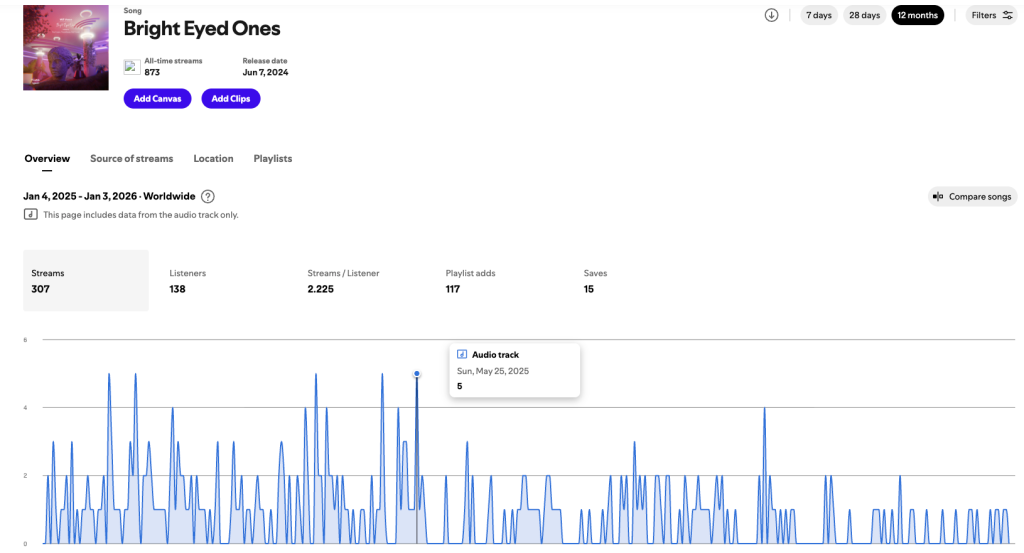
I’ve seen this happen with a couple of my own releases and it’s been the most heartbreaking when it happens to a release that is one of your personal favorites (like my track ‘Bright Eyed Ones’ – though I think this was a lesson learned about putting too much faith in the label to actually promote the music instead of handling it all myself at which point, I might as well release on my own label but hey… lesson learned)
Spotify promotion compresses that feedback loop, which changes how decisions get made.
Instead of waiting months to understand whether a track resonates, artists can observe listener response across multiple contexts within weeks, which allows them to adjust creative direction, promotional focus, or release cadence while the work still feels alive.
This kind of iteration is normal in other creator-driven industries, where rapid feedback is built into the workflow, but music has historically lagged behind due to distribution bottlenecks and slower cycles. Spotify promotion helps close that gap, not by forcing outcomes, but by speeding up clarity.
Promotion Controls Access, Not Outcomes
A lot of confusion around Spotify promotion comes from the belief that it manipulates results directly, when in reality it controls access rather than behavior. A playlist placement does not make listeners care, and a campaign does not compel engagement, but it does increase the number of situations in which engagement can happen.
That distinction matters because it reframes promotion as facilitation rather than validation. When artists chase placements as proof of worth, they end up optimizing for optics, whereas when they treat promotion as a way to increase the surface area of listening, they begin to evaluate success based on what listeners actually do next.
This is why smaller, well-curated playlists often outperform larger ones in terms of meaningful signals, because context shapes behavior just as much as exposure does. Listeners who encounter a track inside a playlist that aligns with their taste and intent are far more likely to save, replay, and explore further than listeners who encounter the same track in a mismatched environment.
Legitimate promotion accounts for this, while shortcuts ignore it.
The Difference Between Artificial Scale and Real Momentum
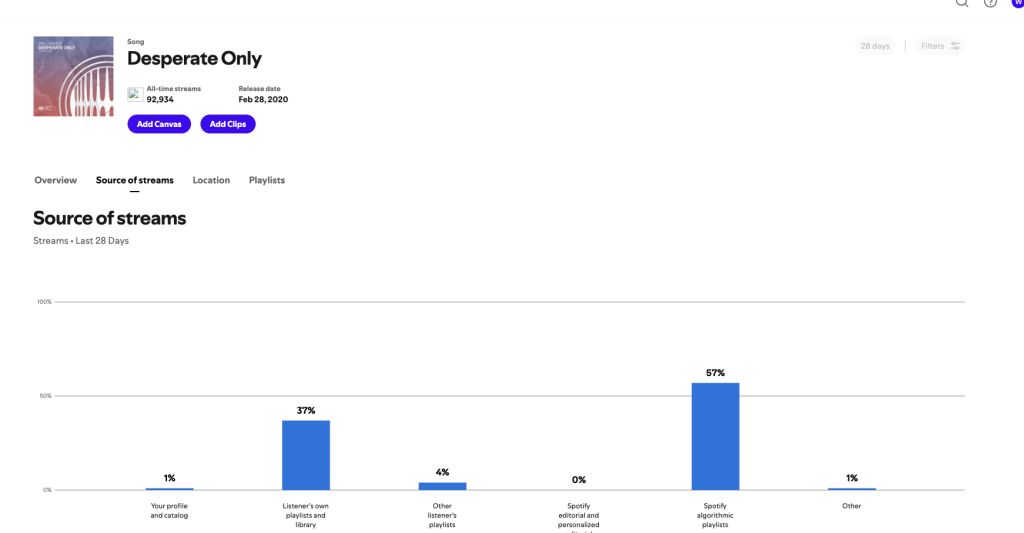
Years of low-quality promotion have made artists understandably skeptical, especially when promises of guaranteed streams or algorithmic shortcuts collapse under scrutiny, leaving inflated numbers with no lasting impact. The problem with those approaches was never scale itself, but the absence of genuine listener behavior behind it.
Spotify’s systems are built to identify patterns over time, not spikes, and when engagement fails to persist, momentum evaporates quickly. Real promotion works in the opposite direction, prioritizing steady exposure across multiple listening environments so that behavior accumulates gradually rather than appearing all at once.
This kind of momentum rarely looks dramatic in the short term, but it compounds quietly, which is often how sustainable growth actually happens.
Why Cross-Industry Thinking Matters Here
What artists are experiencing on Spotify mirrors shifts happening across nearly every creator economy, where platforms drive discovery but ownership determines longevity. Writers rely on distribution platforms to introduce their work, but build stability through newsletters, Discord communities, and sometimes even sites like Patreon. Educators attract attention through marketplaces, but retain students through communities. Game developers launch through storefronts, but sustain engagement through direct channels. While it can be easy to think that it’s only musicians and producers facing this solo’d community-driven ecosystem, it’s pretty much seen in almost every creative niche these days.
Spotify occupies the same position. It introduces listeners, but it does not retain them on behalf of the artist, and once that reality is acknowledged, Spotify promotion stops feeling like a gamble and starts feeling like a component.
Artists who think this way stop asking whether Spotify playlist promotion “works” and start asking how it feeds the rest of their system, which changes both expectations and outcomes.
Where One Submit Fits When Used Intentionally
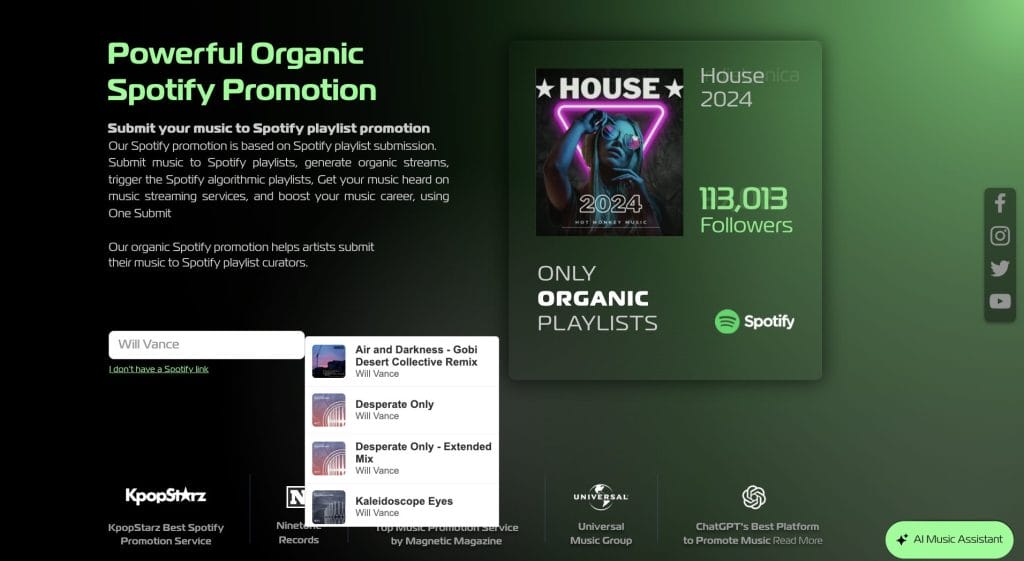
This is where services like One Submit earn their place, particularly for artists who value structure and efficiency without sacrificing control. Manual outreach to curators, blogs, and playlist owners is time-consuming, inconsistent, and difficult to scale, especially when balanced against production schedules and release timelines.
One Submit centralizes that process while keeping the artist involved in decision-making, which means campaigns remain intentional rather than scattershot. Artists select genres, define scope, receive feedback, and observe patterns across campaigns, all of which turns promotion into a repeatable process instead of an emotional roll of the dice.
That repeatability matters, because it allows promotion to integrate into long-term planning rather than disrupting it.
Promotion as Infrastructure, Not Insurance
The artists who benefit most from Spotify promotion tend to approach it as foundational infrastructure rather than insurance or hail-Mary lobs into the void, using it to support a system they are already building instead of expecting it to compensate for gaps elsewhere. They release consistently, understand their audience, and treat each campaign as one data point in a longer arc rather than a referendum on their worth.
When promotion functions this way, it amplifies clarity instead of confusion, and over time, that clarity compounds.
Spotify promotion cannot replace community, identity, or consistency, but when paired with those elements, it removes friction from being heard, which remains one of the hardest problems independent artists face.
The Ceiling Still Belongs to the Artist
Ultimately, promotion does not determine the ceiling of an artist’s career, because that ceiling is shaped by creative output, audience connection, and long-term intent. What promotion determines is how quickly information surfaces and how efficiently opportunities are created.
Artists who use Spotify promotion as a learning tool tend to make better decisions over time, because each campaign reveals something about how listeners respond, where engagement happens, and what deserves further investment. Over months and years, those small insights compound into something that looks like momentum from the outside, even though it was built quietly and deliberately.
That’s the role Spotify promotion plays when it’s understood correctly, not as a shortcut to relevance, but as part of a system designed to endure.