Avantone Pro Targets Studio Accuracy With the CLA-Sub Subwoofer
When new studio subwoofers get announced, I usually scan for one thing first: signs that the design team understands why engineers are skeptical of subs in the first place. The new CLA-Sub from Avantone Pro immediately checked a few boxes for me, not because of marketing language, but because of the specific problems it is trying to solve.
This is a subwoofer aimed directly at producers, mix engineers, and post-production rooms that need low-frequency extension without turning monitoring into guesswork. From the specs and design choices, the CLA-Sub feels less like a “bigger bass” accessory and more like a monitoring tool meant to stay honest when levels go up.
For more information, please visit the product webpage here: https://avantonepro.com/en/products/cla-sub
The Dual-Firing Design Is What I Noticed First
Room interaction is where most subs fall apart, so I was glad to see Avantone address this head-on. The CLA-Sub can be configured in either front-firing mode or downward-firing mode. Front-firing is there for accuracy and predictable translation. Downward-firing uses floor coupling to add up to +3 dB of output, which can be useful in larger rooms or setups that need extra headroom without pushing the driver too hard.
What I like here is that this choice is left to the engineer rather than locked into the cabinet design. The repositionable vibration-damping feet also matter more than people realize. Reducing mechanical coupling and sympathetic resonance saves you from chasing isolation problems later or stacking aftermarket solutions under the sub.
A Driver Design Focused on Control, Not Hype
At the center of the CLA-Sub is a custom dual-magnet driver built specifically for Avantone Pro. The goal here is clear: increase output while keeping distortion under control. Too many subs inflate perceived loudness by leaning into harmonic buildup, which makes things feel impressive at first and unreliable over time.
The stacked dual-ferrite magnet structure is designed to provide tighter control over cone movement, while the rigid paper cone focuses on transient response and reduced overtones. From my perspective, this points toward a sub that is meant to reveal information rather than mask it. That distinction is critical if you are making decisions about low end that need to translate outside your room.
Integration Features That Actually Matter in Daily Use
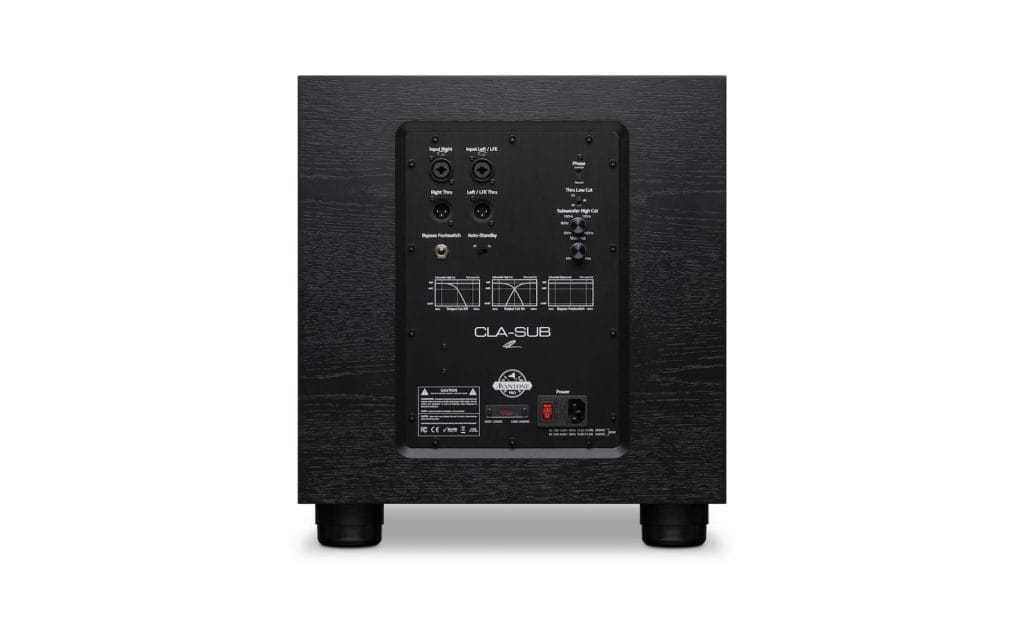
Where the CLA-Sub really starts to feel practical is in its integration options. A sweepable high-cut crossover from 50 Hz to 180 Hz allows you to dial in the transition point properly rather than settling for a fixed guess. Selectable low-cut filters at 80 Hz or 100 Hz for connected monitors make it easier to build a clean 2.1 system without external processing.
Phase and volume controls are onboard, which is expected, but the inclusion of a bypass footswitch input stands out. Being able to A/B your mix instantly with and without the sub is one of the fastest ways to keep low-end decisions honest. Add locking XLR and ¼-inch TRS combo inputs, and it becomes clear this unit is built to stay put even when pushed hard.
Auto-standby is also here, kicking the sub into low-power sleep after 30 minutes of inactivity, which is a small but welcome touch in studios that stay wired 24/7.
Where I See the CLA-Sub Fitting In
From everything Avantone is outlining, the CLA-Sub feels aimed at engineers who already understand their rooms and want extension without losing trust in their monitoring chain. This is not a sub designed to impress clients with exaggerated lows. It reads as something meant to move air, reveal detail, and stay consistent at higher playback levels.
The CLA-Sub is available for pre-order now and is scheduled to ship globally in April 2026, with a US MAP of $1,299 USD and an EU price of €1,729 EUR including VAT. I am genuinely curious to hear this one in a controlled room, because on paper, it addresses many of the reasons engineers hesitate to add a sub in the first place.