“Music often speaks before language does” Hayden F interview
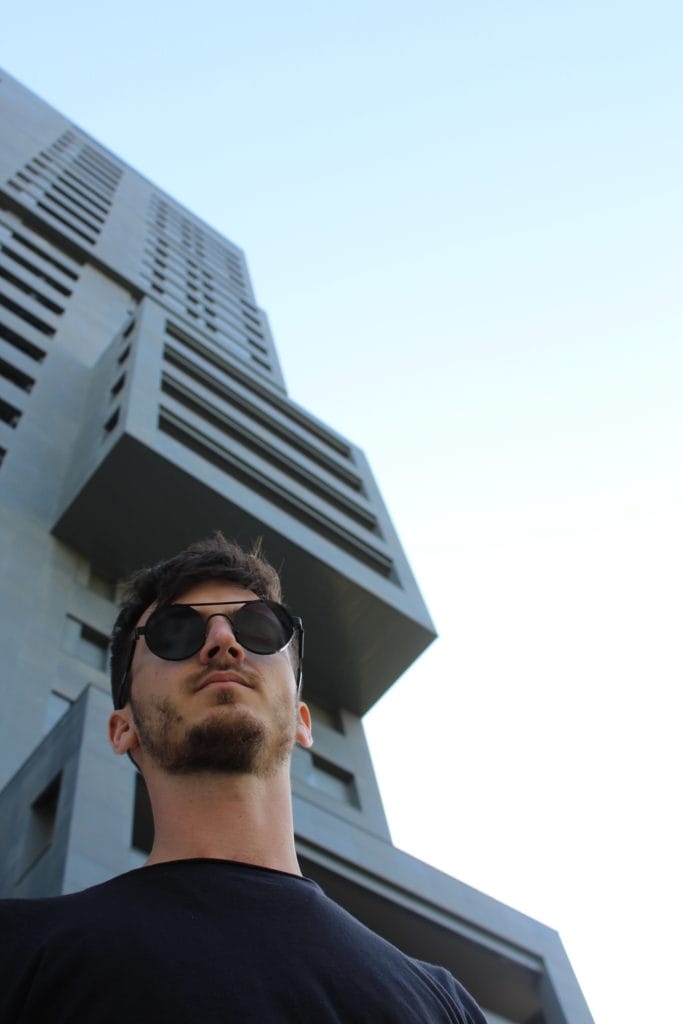
Hayden F has built his sound around subtle pressure rather than obvious release. His productions favour repetition, restraint, and small shifts in energy, leaning into mood and texture over overt narrative. It is a style that rewards patience, where minimal harmonic ideas and evolving sound design are given the time to settle and do their work.
Hayden has put together a fascinating studio video that documents the making of his track Between The Lines exclusively for us here at Magnetic. This interview zooms in on that approach.
Taken from his new Thoughts and Prayers EP, the track acts as a focal point for a wider discussion around intuition, instability, and trusting feel over force. Together, the video and conversation offer a clear sense of an artist who values process, space, and quiet conviction above all else.
Hayden F Interview
You describe the starting point as a very simple minor chord pattern. What tells you when a minimal harmonic idea has enough emotional weight to carry an entire track?
Most of the time, you don’t analyze it, you feel it. If a few notes can live on repeat for a long time without losing their impact, if they keep triggering something physical or emotional, then they already carry enough weight. For me, that’s the real test. I start from a very simple belief: if it resonates deeply with me, it doesn’t need further justification.
I try not to rationalize this stage too much.
Music often speaks before language does, and I trust that this kind of honesty will naturally find its listeners.
You talk about wanting the mood to feel introspective but still raw and physical. How do you balance those two impulses when you are designing sounds and arranging energy?
I don’t really see them as opposites. It’s more about finding a balance where each element has a clear role. Emotionally, but also technically.
Every sound needs space, its own place in the spectrum, its own reason to exist. When that’s respected, introspection and physicality can reinforce each other. You can bring together very different energies as long as the whole feels unified, like everything is moving in the same direction rather than competing for attention.
Reverse delay and saturation play a big role in pushing the melody forward. At what point does processing stop enhancing the feeling and start getting in the way, and how do you recognise that line?
Usually when you start forcing complexity. If you feel the need to constantly add layers or processing to make a sound interesting, it often means the foundation isn’t strong enough.
The core elements should already work on their own. Saturation is especially tricky. When it’s applied everywhere without intention, it flattens the music. You lose contrast, everything becomes equally loud and present, and the track stops breathing. Knowing when to stop is mostly about listening for space, not density.
The percussive synth feels central to the movement of the track. What draws you to tools that rely on instability, LFOs and micro variation rather than fixed patterns?
I’ve always been drawn to unpredictability. I like leaving room for things I don’t fully control. That mirrors real life. We’re constantly reacting to situations rather than mastering them. In electronic music, tools based on instability allow that kind of dialogue. LFOs, micro-variations, small fluctuations… they introduce movement and tension without me having to over-design everything. Letting the machine surprise you is part of the beauty.
You mention enjoying how hypnotic the plugin is to watch as well as hear. How much does the visual feedback of a device or plugin influence your creative decisions in the studio?
Visual feedback doesn’t dictate my choices, but it definitely shapes the experience. It makes the process feel more alive, more physical. Some developers manage to translate sound behavior into a visual language that feels coherent and meaningful.
Plugins like Metal or Thermal are good examples. You can sense that the visual design isn’t decorative, it’s part of the instrument. That kind of coherence makes you want to spend more time listening.
What does organic mean to you in a production context, especially when working with digital tools?
For me, “organic” is about creating a physical illusion. Melodies that feel almost vocal, percussions that suggest real materials or gestures. I love digital tools, but I’m always looking for traces of reality inside them. It can be a recorded sound, an imperfection, or the natural saturation of analog machines. These elements anchor the music in something tangible, something human.
How has your relationship with distortion and texture changed over time as your sound has developed?
It evolved in phases, like any relationship.
At first, I barely used it. Then I went through a period where it was everywhere. Now I try to be more disciplined. Distortion is powerful, but it can easily create problems later if it’s overused. When applied with intention, it softens edges, adds harmonics, and helps glue elements together. In a way, it can even make a track feel more minimal by unifying space rather than filling it.
You describe the final stage as creating a dialogue between elements rather than locking into a rigid structure. When you are arranging, what tells you that a conversation between parts feels alive rather than overworked or predictable?
I often record arrangements live, directly from clips using Ableton Push.
By doing things by hand, mistakes naturally happen, and those mistakes often lead to ideas I would never design intentionally. It also avoids the rigid, mechanical feel that can come from working only with a mouse. In the end, I trust my instinct. When I start feeling bored, it’s usually because the music is. Even at its densest moments, the track should feel open, not overloaded, like everything is speaking clearly.
Thoughts and Prayers EP is out now on Silencio Records