Telepathic Instruments Orchid Review: A Cool Quirky Chord Synth Built For Inspiration
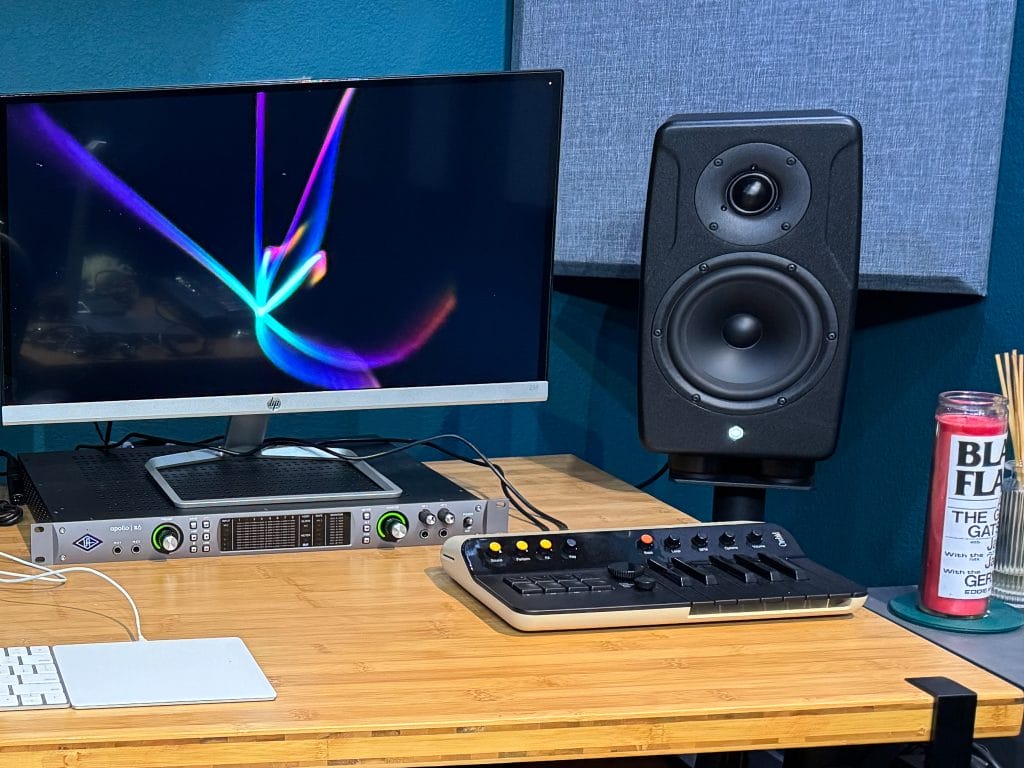
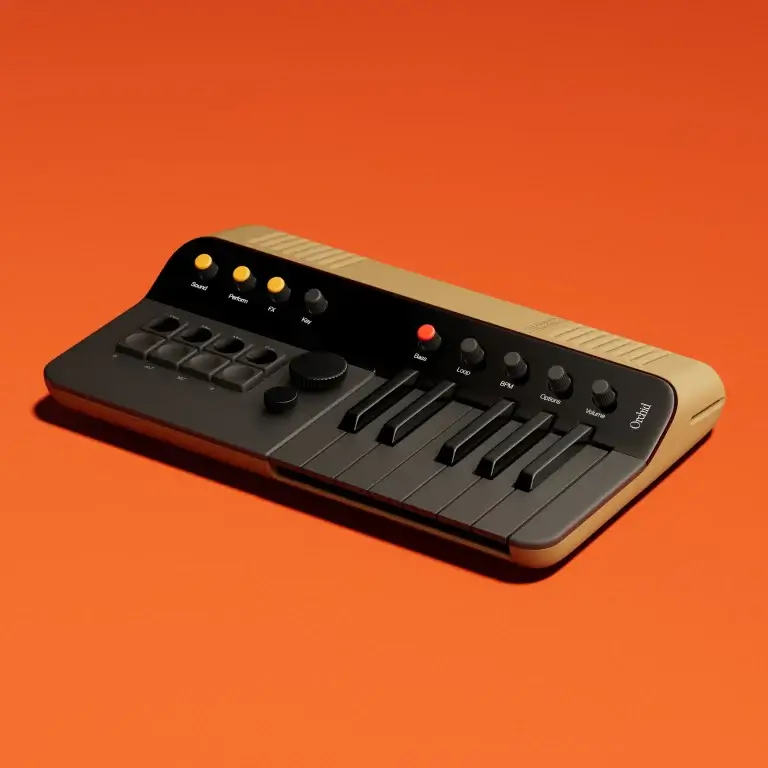
When I first saw the Telepathic Instruments Orchid, I wanted it. Immediately. The design looks like something from the 90s had sex with something from the 70s, and you get a Mac/WORProcessor/IBM typewriter-looking thing with one octave worth of keys, some knobs, and a lot of mystery. Even the marketing was mysterious; you couldn’t tell if you were the joke, it was the joke, or it was a legitimate device.
So when I was at ADE back in October and saw the Telepathic Instruments Pop Up store, I walked in and purchased within five minutes. I’m thrilled I did. Let’s talk about this thing, and hopefully I can illuminate you a bit on what it does and why you might want it, or not want it.
Some synths, like the Korg Minilogue XD, want you to master them. Others want to get ideas out of your head before they evaporate, like many of the grooveboxes out there. The Telepathic Instruments Orchid is wedged between these two mentalities.
This is a portable chord synth, creative MIDI controller, and songwriting instrument designed less like a traditional keyboard and more like a harmonic idea generator that happens to make sound.
Telepathic Instruments Orchid Review At A Glance
It’s also impossible to talk about Orchid without mentioning its origin story. Telepathic Instruments was co-founded by Kevin Parker (Tame Impala), and Orchid is something Parker has publicly described as an idea he’s been carrying around for over a decade. That context matters, because Orchid feels like it was built by someone obsessed with chords, voicings, and emotional movement—not by someone trying to win a spec war. If it makes sense, it feels very Tame Impala-ish.
The Orchid is a chord-based synthesizer for producers, songwriters, and electronic musicians who want to get to interesting harmony fast, you could think of it as healthy fast food. I call it an idea machine with secrets. If you are deficient in musical theory and barely know where middle C is, then you are going to love this machine, and it might even help you learn some piano, with the assistance of the ROLI Piano and Airwave.
Build quality and design:
The Orchid is designed to live everywhere; it’s a machine that wants to be seen and almost commands it. It’s compact, has an onboard battery, and even some decent built-in stereo speakers. It’s meant to be moved around, although my one big grip is that for that kind of money $650 US, it should have come with a carrying case.
The Orchid is something you can pop out on the airplane, or at the coffee shop, and start noodling on with your headphones on when creativity strikes, but be warned, someone is going to creep over, oogle it, and then ask you about it.
The single-octave keyboard is velocity-sensitive, but it’s clearly not meant for traditional two-handed playing; it’s something to be noodled on.
The real action happens above the keys, where Orchid’s chord buttons, voicing controls, and encoders live. The OLED display is clean and readable but a bit dull, the knobs feel deliberate and a little toy-like in the best possible way, and the overall layout encourages exploration instead of muscle memory.
This isn’t “luxury boutique metal slab” territory, but it also doesn’t feel disposable. The build matches the philosophy: sturdy enough to move around, light enough to invite use, and designed to reduce friction between idea and output. If you mess with the Sound, Perform, FX, and Key buttons alone, you are going to come up with some cool riffs guaranteed.
What Orchid actually is: a chord synth first, everything else second
At its core, Orchid is a chord generator. You choose a root note on the keyboard, select a chord type, and then layer extensions and modifiers on top. Two dedicated voicing controls for lead and bass let you walk through inversions one note at a time, turning voice leading into something tactile rather than theoretical.
For those of us who don’t know how to play piano, it’s fantastic to see the chord and key flash on the screen, which in turn helps you develop a better ear.
From there, Orchid adds motion through performance modes like arpeggiation, strumming, pattern playback, and harp-style cascades. These aren’t just effects slapped on top; they fundamentally change how the harmony behaves rhythmically. That’s why Orchid often feels like it’s “suggesting” melodies rather than forcing you to program them.
There’s also a dedicated bass section, which means Orchid can sketch out harmonic structure and low-end intent simultaneously. It’s surprisingly effective for quickly blocking out full musical ideas, especially if you think in chords first and instrumentation later.
If you like to lay down your drum programming first, then the Orchid can be plugged into your audio interface, and you play right into your DAW and chop it up later.
Sound engines and presets: do the onboard sounds hold up?
Orchid includes multiple digital synth engines—commonly described as virtual analog, FM, and a reed/piano-style engine—along with onboard effects like reverb, chorus, and delay. On paper, that reads like a modest synth spec. In practice, the sounds are designed to be immediately usable rather than endlessly tweakable.
The presets don’t scream “flagship polysynth,” but they don’t need to. They’re voiced to complement the chord engine, meaning pads bloom in the right places, keys emphasize harmonic color, and leads sit comfortably on top of dense voicings. The sounds are good enough to record, but more importantly, they’re good enough to inspire.
Think of Orchid’s audio as a creative sketch, not the final painting. If you’re the type who replaces placeholder sounds later with your favorite soft synths or hardware, Orchid fits neatly into that workflow.
In a studio, Orchid really shines as an idea-generating instrument; it’s like having a writing buddy in the studio that never runs out of ideas.
For me, the bullseye is using it to explore chord progressions, voicings, and rhythmic movement without staring at a piano roll hoping for the best.
A typical workflow looks like this: build a progression on Orchid using chord types and extensions, explore inversions until the movement feels right, then engage a performance mode to imply melody or rhythm. From there, you capture MIDI into your DAW.
This is where Orchid gets professional-grade and is worth the price point. It sends different musical roles on separate MIDI channels—chords, performance notes, and bass—making it easy to route each part to different instruments once the MIDI hits your DAW.
Pads become pads, arps become leads, bass becomes bass, and suddenly you’ve got a structured musical idea ready for deeper production.
Used this way, Orchid becomes a harmonic brain for your studio. You let it do what it’s best at—generating interesting musical DNA—then you finish the job with your usual tools.
Updating: modern, mostly painless
Firmware updates are handled through a browser-based WebMIDI updater, which feels very “modern instrument” for better and worse. I just went through the update process for the first time, and it was dead easy: plug in via USB, switch to MIDI mode via the Options dial, and click the green button on your browser. About ten minutes later, the Orchid was updated and ready to go
There’s no driver hell, but you do need a compatible desktop browser. Once connected, updates are straightforward and relatively quick.
Telepathic Instruments has also positioned Orchid within a broader ecosystem, including a companion plugin that mirrors and extends its sound engine. That plugin angle reinforces what Orchid really is: a hardware front end for ideas that don’t want to stay trapped in hardware.
Who Orchid is for (and who it isn’t)
Orchid is ideal for producers, electronic musicians, and songwriters who think harmonically but don’t want to overthink theory every time they sit down. It’s especially appealing if you’re bored with the same progressions, tired of scrolling through MIDI packs, or looking for a portable songwriting synth that actually sparks ideas.
It’s less appealing if you want a traditional keyboard experience, deep synthesis control on the front panel, or a do-it-all workstation. Orchid is opinionated and a specialist; that’s the point.
Is the Telepathic Instruments Orchid worth the price ($650 US)?
The Orchid’s price has fluctuated by region and release cycle, and it’s undeniably premium for a compact digital synth. Whether it’s worth it depends entirely on how you value inspiration.
If you judge it like a conventional polysynth, it’s expensive. If you judge it like a dedicated creative tool that reliably generates musical ideas, the value proposition makes more sense. You’re paying for workflow, not raw horsepower.
It’s also going to bring something unique to your productions, at least for a while as there are so few units out there. I had a lot of fun just running it through my mixer and playing live loops with it while layering in more percussive tracks, so the versatility is endless.
For musicians who already own plenty of synths but still struggle with starting songs, Orchid fills a very specific—and surprisingly rare—gap.
Final thoughts
The Telepathic Instruments Orchid isn’t trying to be everything. It’s trying to be the thing you reach for when you want to move forward instead of sideways. As a chord synth, MIDI generator, songwriting tool, and portable inspiration machine, it succeeds by narrowing its focus.
If your studio already has plenty of sounds but could use more ideas, Orchid might be exactly the missing piece. It won’t replace your favorite synth—but it might replace the moment where you don’t know what to play next.
Now, the bummer: they are on backorder, so all you can do is wait or pay too much on eBay. You can get on the waiting list on the Telepathic Instruments Website HERE