TOPPING Mini 500: A Compact Powerhouse for Passive Speakers
Images Courtesy of Apos
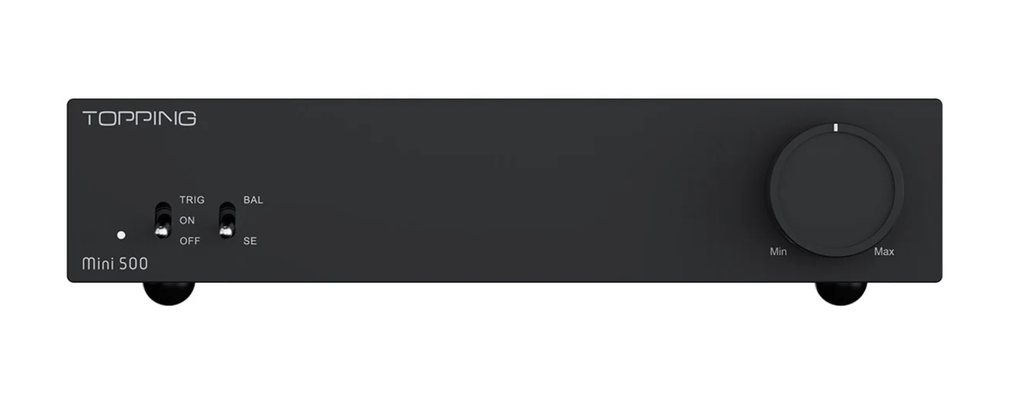
TOPPING has released the Mini 500, a $229 desktop power amplifier that provides considerable output for its size while accommodating several different listening configurations. The fully balanced Class D amplifier delivers 220W per channel into 4-ohm speakers at less than 1% THD+N, with the option to switch to mono operation to drive a single speaker or passive subwoofer. It also includes balanced and unbalanced connections, an analog volume control, and a compact aluminum enclosure measuring just 7.48 inches wide.
The specifications are interesting because TOPPING has concentrated on amplification rather than adding streaming, digital conversion, or wireless connectivity. The Mini 500 is designed to receive an analog audio signal from an existing source and amplify it for passive loudspeakers. Depending on the rest of the equipment, that could mean connecting a DAC directly to the amplifier, using an external preamplifier, or incorporating the Mini 500 into an existing hi-fi system.
TOPPING Mini 500 Power Ratings Explained
The Mini 500 uses Class D amplification with a native bridge-tied load, or BTL, architecture. This design uses differential output stages to drive the speaker, allowing the amplifier to deliver power without necessarily connecting the speaker’s negative terminal to chassis ground. Class D amplifiers are commonly used in compact audio equipment because their switching architecture can provide high electrical efficiency compared with conventional linear amplifier designs.
In stereo operation, the amplifier provides:
- 220W per channel into 4Ω at THD+N below 1%.
- 120W per channel into 8Ω at THD+N below 1%.
- 250W per channel into 4Ω at THD+N below 10%.
- 150W per channel into 8Ω at THD+N below 10%.
The distinction between the 1% and 10% figures deserves attention because manufacturers sometimes advertise the highest possible output without explaining the associated distortion threshold. For the Mini 500, the 220W and 120W stereo figures provide a more informative comparison when evaluating power output at the lower stated distortion threshold.
Balanced Inputs and Volume Control Simplify System Integration
The Mini 500 provides two input configurations: balanced XLR/6.35mm TRS combo connections and conventional RCA connections. The balanced inputs are particularly relevant to listeners who already own DACs, preamplifiers, or professional audio equipment with balanced analog outputs. TOPPING uses a fully differential signal path to reduce interference shared between the two conductors of a balanced connection.
The amplifier also offers two volume control methods. In VOL mode, the front-panel analog potentiometer adjusts the listening level. In BYPASS mode, the volume control is removed from the signal path, allowing an external preamplifier or DAC with adjustable output to determine the listening level. One important caution concerns BYPASS mode: the amplifier operates at fixed maximum volume when the front-panel control is bypassed. TOPPING advises reducing the upstream device’s output level before switching modes to avoid unexpectedly high speaker volume.
How the Mini 500 Compares With Integrated Amplifiers
At $229, the Mini 500 sits in a different category than integrated streaming amplifiers that combine digital conversion, networking, and speaker amplification. The Mini 500 provides an additional amplification option for compatible passive designs, although speaker selection remains an independent decision. The aluminum enclosure measures 7.48 inches wide, 6.46 inches deep, and 1.73 inches high, weighing approximately 2.4 pounds. Available finishes include black, silver, and white, and Apos and participating retailers list the unit at $229.